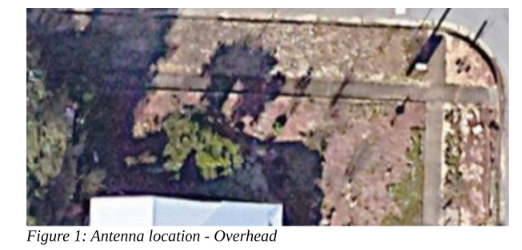
So, as some of you know, I purchased the ARRL’s End-fed, Half-Wave antenna last year (yeah, I know, stop judging). I followed the instructions to build the balun and carefully sealed it to prevent water intrusion into the box. Today, I finally made the time to put it up. First, let me lay out some of my challenges for this build/installation. Firstly, there is the space available. If you take a look at the image below, you can see, there really isn’t a lot of room to stretch the wire in a straight line.
Here is a view from the street:
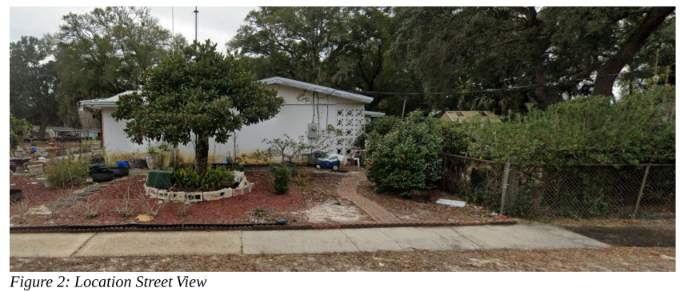
As you can see, there is a lot going on here and some obstacles I needed to avoid, the most important one, the overhead power lines that feed Casa de KQ4ATC. This means, to keep from crossing the power lines, I needed to come straight out from the mast holding the Comet GP-9 I use for VHF/UHF. Seen in this next image up next to the house.
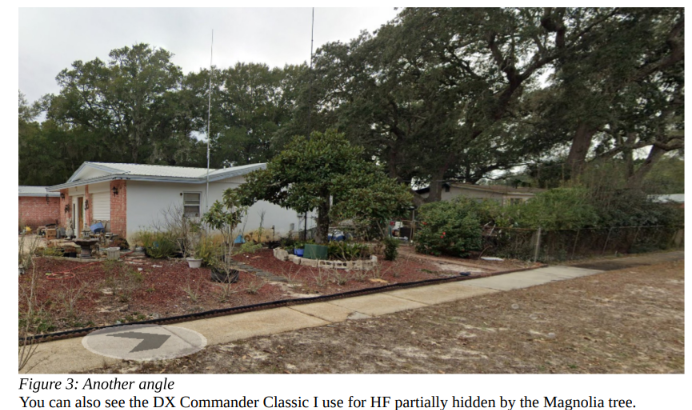
Now that you can see the space I have to work with, lets gather our supplies and get to work, shall we? Of course, we have the EFHW and a chunk of coax. That turned out to be the easy bit. Next up, I required a method to keep the antenna as high as possible in the space provided. A few months back, while on a Costco run, I found a set of poles intended to be used for string lights.
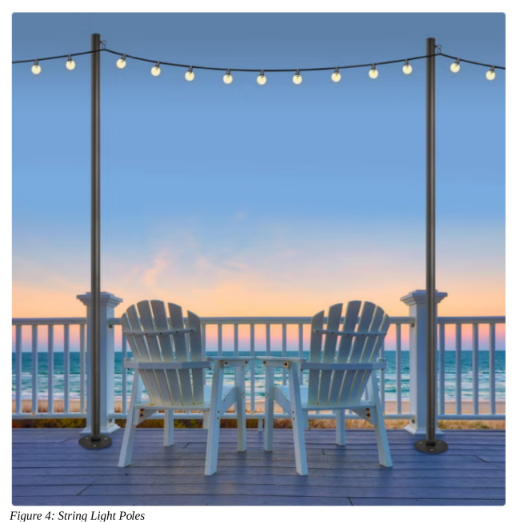
These are fairly study and have a variety of mounting options, to include ground screws. These come as six separate sections of pole that screw together and are a little over three feet for each section. The poles measure 10’ from the mount to the top of the third section. I also required a collection of zip ties and a couple of lengths of paracord (I chose black for this project). First step, hang the balun and wire from the GP-9 mast. As you can see, it is below the VHF/UHF antenna mount. I also took this opportunity to connect the coax to the balun so I wouldn’t have to bring the mast down again just to connect it.
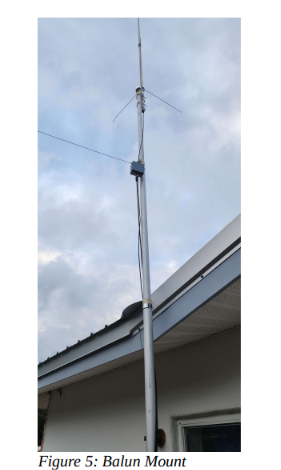
I also wrapped a choke in the coax as recommended by others who have built or installed one of these antennas. It’s not visible in this photo, as I placed ~ 10 from the feed point. I chose this spot based upon some of the same information I read which indicates the shield of your coax can act as your counterpoise. After some testing and use, I may go ahead an add a counter-poise later to see if there is an improvement in this antenna’s performance.
Next, I put up the first support post just to the outside of the Magnolia. Here I used 4 sections of the kit and one of the ground screws. (Hint: if you decided to utilize this kit, when putting in the ground screws, be sure to press down with some weight and use the provided tool to install it. You will thank me later.)
To prevent twisting the antenna wire around the post, I placed a loop of paracord through the provided eye and after standing the pole upright, I used the cord to haul the antenna up. I tied off the paracord to the pole and added a zip tie above the knot to help prevent slippage. This will become an inspection item to ensure the wire stays in place. While I haven’t measured it, at this point, the antenna is ~13 feet in the air.
Another benefit is this helps keep the turn at greater than 90 degrees. Everything I read said this is critical, but none of the writers bothered to indicate why. The only thing I can come up with is if the inside corner is less than 90 degrees, the antenna pattern along each leg will cancel each other out at that point. Finally, I place the remaining sections in the back yard and secured the antenna wire using the provided insulator from the kit and a length of paracord. The terminus is ~7’ high.
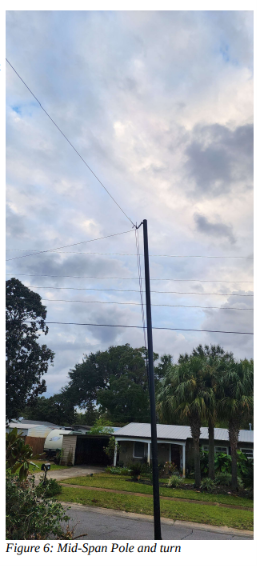
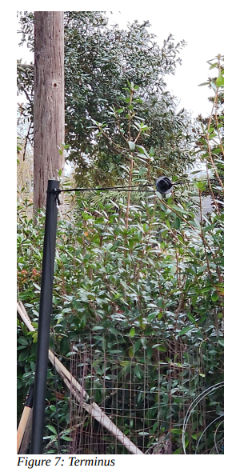
SWR readings after some adjustments of where the antenna landed and getting it high enough at the end, varied some, but all mostly around 2.0:1 or so. I’ll be keeping an eye on it as I use it. But so far, I am happy with its performance. The Yaesu FT-991A tuned up on 20 Meters and I have made a couple of contacts. The first station I heard was out of New Mexico who was booming it at about +10 and I listened to a station out of Dallas/Fort Worth who was about the same. I hit two POTA activators, one in Texas, the other in Iowa. I take RST from POTA with a grain of salt as they want to close the QSO and move on.
More to come
KQ4ATC