PARC | Ham Radio

The Best Amateur Radio Club in Florida

WIRES-X: Expanding Amateur Radio Communication Globally

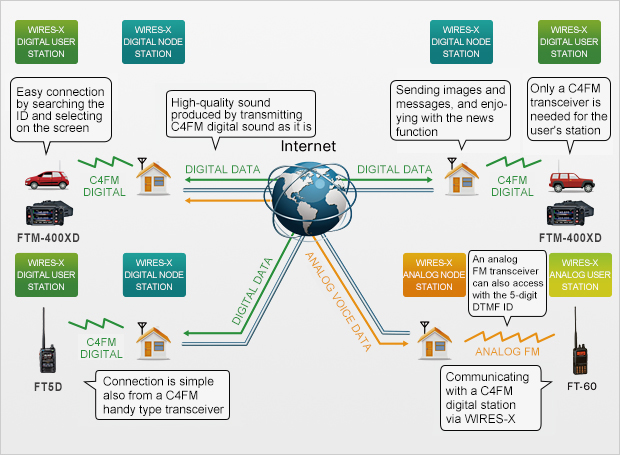
Using WIRES-X for a communication

Playground Amateur Radio Club, Inc has a Wires-X!

91172 01172 AA0EU Fort Walton Beach Florida USA
WIRES-X (Wide-coverage Internet Repeater Enhancement System) is a revolutionary technology developed by Yaesu to significantly expand the reach and possibilities of amateur radio communication. By leveraging the Internet, WIRES-X connects conventional amateur radio stations worldwide, supporting both analog and advanced digital modes.
How WIRES-X Works
• Local Nodes: At the heart of the WIRES-X system are local nodes—radio stations (transceivers or repeaters) connected to the Internet via a PC. These act as access points, relaying traditional RF (radio frequency) signals into data packets for Internet transmission and vice versa.
• Rooms: The WIRES-X network introduces the concept of Rooms, communal digital spaces where multiple nodes can connect, enabling group conversations similar to a conference call.
• Repeater Linking: Multiple repeaters can be linked over vast distances, allowing seamless communication between amateur stations far outside normal radio range.
Key Features
• Support for C4FM Digital Voice: WIRES-X is notably built to work with Yaesu’s C4FM (Continuous 4 Level FM) digital voice system, providing clear, reliable audio and supporting simultaneous transmission of text, images, and other data.
• Analog and Digital Flexibility: While optimized for digital communication, WIRES-X also maintains compatibility with traditional analog FM, allowing operators with older equipment to participate (through analog nodes).
• Personal Digital Nodes: Users can set up their own personal or portable digital node with a compatible radio and PC, enabling access to the global WIRES-X network even from temporary or mobile locations.
Proprietary Network Structure
• Yaesu Infrastructure: Unlike open-source alternatives, WIRES-X is built on proprietary technology, with servers managed by Yaesu, primarily in Japan. Node and repeater connections require specific hardware, notably the HRI-200 Internet interface.
• Room Creation and Management: Licensed amateur operators can create and manage their own rooms, controlling who can access and participate, which is useful for clubs, emergencies, or special events.
Typical Applications
• Global Communication: Operators can connect from one side of the world to the other using modest radio equipment and a local node, bypassing the natural limits of VHF/UHF propagation.
• Data Exchange: Besides voice, users can exchange GPS location data, pictures, and short messages, leveraging the digital backbone of the system.
• Portable Operation: With the Portable Digital Node function, hams can quickly deploy mobile nodes at events, in emergencies, or during DXpeditions, using only their radio and a computer.
Comparison with Other Digital Linking Systems
While WIRES-X is similar in its aim to other systems such as Echolink, DMR, or BrandMeister, it is tightly coupled to Yaesu’s hardware ecosystem and the C4FM digital standard. Access to the WIRES-X system generally requires compatible Yaesu radios and the HRI-200 for node operation, which some hams view as a trade-off for the system’s stability and feature set.
Limitations and Etiquette
• Shorter operating sessions and adherence to established protocols (e.g., leaving several seconds between transmissions) are encouraged to prevent congestion and enhance accessibility on popular nodes and rooms.
• Use of the system may be restricted by local regulations, hardware requirements, and the need for Internet connectivity.
WIRES-X has made a profound impact on the amateur radio community by bridging the gap between traditional RF operation and modern digital, internet-based communication. By providing an accessible, robust, global platform for both voice and data, it continues to shape the future of amateur radio.

The Frankantenna is Vertical!

What do you do on a Sunday following a road trip?! Show up at the Pile-Up [during a heatwave] and erect an HF Vertical! This just goes to show that there is a safe way to eat a banana! In any light, other than massively long hotdogs, this weekend, members from PARC gathered to finish the raising of the HF Vertical! “IT’S BAAAAACCCK!

The Playground Team still has some work to do to connect it, but it’s one run of coax away from operational use! Then onto the next antenna project to enhance the Club’s already astounding communications capabilities! Curious?! Look at the Club Calendar and stop in to see for yourself!

On That Road Again

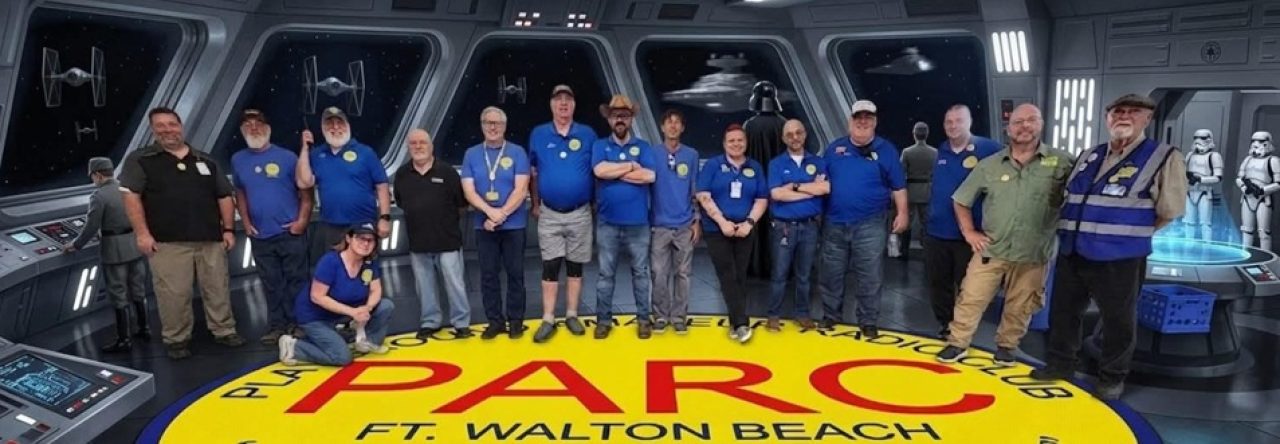
Did you travel to the Milton ARC Hamfest?! Okaloosa County sure participated! Members from PARC, NOARC, EARS, Twin Cities, and other Hams not affiliated with clubs or Orgs sure did! While we were not able to get a photo opportunity with all of them, we did manage to get a couple!

It was great to see friends, Hams, and others that we call call family while expanding our joyous hobby! If you find the time, take part, and interact with your fellow hams, and friends! Keep sharing the joy and be sure to be inclusive of all!

6 Meters, the former 5-meter VHF band that HF’s the World Over!

Amateur radio operators refer to the 6-meter band as “HF” due to its unique propagation characteristics, which can be like those of the traditional HF bands, especially during certain times like sunspot maximums. While technically in the VHF range, six meters exhibits long-distance propagation via F-layer skip, a mode more common on HF, allowing for worldwide contacts.

Here’s a more detailed explanation:

  • VHF vs. HF:
    • The 6-meter band (50-54 MHz) is officially classified as a VHF (Very High Frequency) band. However, it also exhibits characteristics of HF (High Frequency) bands, particularly during periods of high solar activity.
  • F-layer skip:
    • During solar maximums, the ionosphere’s F-layer becomes more ionized, enabling signals to be reflected over long distances, a phenomenon more commonly associated with HF bands. This can lead to worldwide contacts on six meters, earning it the nickname “magic band”.
  • Other Propagation Modes:
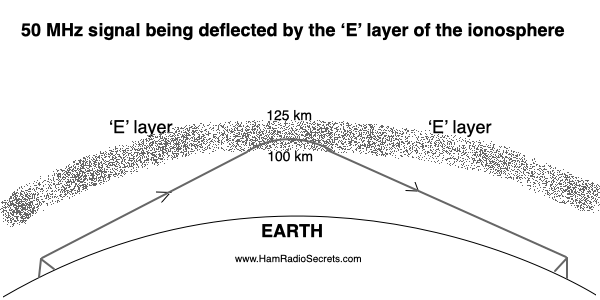
    • Besides F-layer skip, six meters also benefits from VHF propagation modes like sporadic-E, aurora, and meteor scatter, making it a versatile band with diverse propagation possibilities.
  • Historical Context:
    • The 6-meter band was originally part of the 5-meter band before being shifted to its current location. The propagation characteristics of the band, particularly the ability to achieve long-distance contacts, led to it being referred to as HF by some hams.

Pictorial diagram showing how the 'E' layer of the ionosphere deflects 50 MHz signals back toward the surface of the earth, thus contributing to 6 meter ham band activity.

Is NOAA Weather Radio down in your area?!

Is NOAA Weather Radio down in your area?!

That’s a question that our Green Bay Mike and Key Club Memeber W9MWP asked us. The long and short of it is no, the area NOAA Alerter is operating. But wait, that doesn’t mean it will not be at some point as the NOAA performs upgrades to the system nationally.

NOAA is doing updates to their VHF weather broadcast system. The station in Green Bay 162.55 MHz. is currently still on the air, but if you notice some day it is off this may be why. I found this on the publication Amateur Radio Newsline.

After checking the NOAA website a list of stations can be seen on a nationwide map that are off the air temporarily. A link to that web page can be found here:

NOAA Weather Stations Off Air https://www.weather.gov/nwr/outages. I realize not everyone cares or even knows about the stations but I believe many hams monitor our local outlet. The article explains the update plan well.

To my friends in Fort Walton Beach your station is KEC86 in Pensacola, on 162.4 MHz.

Michael W Pickett W9MWP

Playground Builds a Frankantenna!

Ok what?! Its true! The team at the Playground Amateur Radio Club has been busy the last few Pile-Ups with multiple projects occurring at once in true Sunday Pile-Up fashion! One of note is from a post a while back where we were donated an old, broken, worn, and in need of help Cushcraft R9. Well we at the Playground Amateur Radio Club just so happened to have an old, broken, worn, and in need help Chushcraft R7.

Over the last 3 weeks, a majority of the team (old, new, and interested members and guests) have donated thier time to step in and help tear the two old verticals apart and rebuild them into a singular tuneable and usable HF vertical! Today marked a milestone in assembly of all sections and erecting it for testing and WOW the results!

Thank you to all members and visitors who partook in this venture to enhance the communication capabilities of the Playground Amateur Radio Club and enhance each other’s skillsets!

Testing this Frankantenna resulted in great and usable SWR on the following bands

* 80 meters (3.5 MHz)

* 40 meters (7 MHz)

* 30 meters (10 MHz)

* 20 meters (14 MHz)

* 17 meters (18 MHz)

* 15 meters (21 MHz)

* 12 meters (24 MHz)

* 10 meters (28 MHz)

* 6 meters (50 MHz)

This asset will be in service by the end of July and the Playground Team will be pressing forward with other antenna projects soon to come! Do you want to see and or use them? Stop on by the Club by checking the club calendar for when we will be there!

Field Day 2025 is a Wrap!

PARC met at Fred Gannon State Park in Niceville Florida and utilized back pack radio kits to communicate in multi-mode operations while teaching young and old hams the tricks to making the most of their time and mentoring others as to how to set-up, tune, and troubleshoot any issues that would prevent a barrier to communications!

Mayor Daniel Henkel even stopped in and was very inquisitive on our capabilities and how we can provide communications for the community with limited operations for emergency situations! But mostly we explained that Field Day is about “FUN” and teaching others how to communicate away from brick and mortar facilities operating in a remote capability to ensure message handling and specialized traffic information is reported and recorded!

Did you make Field Day?! Did you miss Field Day? What was your impression? We want to hear from you as the Amateur Radio Community is always willing to hear feedback and evolve with your interests in mind! Be a part of the conversations and radio operations by joining us at the Playground Amateur Radio Club!

W4ZBB/K4FWB Repeater Site Visit

W4ZBB/K4FWB Repeater site visit and familiarization tour for Rey and Mike! This team along with others are actively maintaining the area repeaters helping to keep you on the air!

The Eglin Amateur Radio Society

The Eglin Amateur Radio Society is an amateur radio group associated with Eglin Air Force Base in Florida. While detailed current information about the society is limited, some historical context and activities can be outlined.

Eglin Air Force Base, located in the western Florida panhandle near Valparaiso, Florida, is a major U.S. Air Force installation established in 1935. It serves as a test and evaluation center for Air Force weapons and systems. The base has a long history, including significant military and technological activities during World War II and beyond.

The Eglin Amateur Radio Society has been known to operate from the base, as evidenced by a 1969 illustrated QSL card mailed by the society from Eglin Air Force Base to New York. QSL cards are confirmation cards exchanged by amateur radio operators to confirm two-way radio communications, indicating that the society was active in amateur radio communications at least as far back as the late 1960s.

Amateur radio societies like the Eglin Amateur Radio Society typically consist of licensed amateur radio operators who engage in radio communication as a hobby and public service. These societies often provide a platform for experimentation, emergency communication support, and community engagement within the amateur radio community. Given Eglin Air Force Base’s technical and military environment, the society likely supports both recreational and operational communication interests of personnel on base.

Amateur radio itself has a rich history dating back to the early 20th century, with organizations such as the American Radio Relay League (ARRL) advocating for amateur radio operators in the United States. Groups like the Eglin Amateur Radio Society contribute to this tradition by fostering radio communication skills, technical knowledge, and camaraderie among members.

The Eglin Amateur Radio Society is a historic amateur radio group based at Eglin Air Force Base, known for its participation in amateur radio communications since at least the 1960s. It serves as a community for radio enthusiasts at the base, supporting both hobbyist and potentially operational communication activities linked to the Air Force environment.

In more recent history,  the Eglin Amateur Radio Society received an anonymous donation to replace aging antenna systems to keep W4NN and its APRS W4NN-1 on the air. It’s current team are highly skilled professionals within the Amateur Radio Hobby and technology  along woth professionals in the Eglin Military Complex.

Antennas Galore: Ham Radio in Fort Walton Beach, Florida

Antennas Galore: Ham Radio in Fort Walton Beach, Florida

Fort Walton Beach, Florida, is a vibrant hub for amateur radio enthusiasts, where antennas of every shape and size dot the landscape—from attics and rooftops to beaches and parks. The local ham community, anchored by the Playground Amateur Radio Club (PARC), showcases the diversity and ingenuity of antenna setups that make ham radio both a technical challenge and a rewarding hobby.

A Community Built on Waves

PARC, located at 17 First Street SE in downtown Fort Walton Beach, serves as the epicenter for local hams. The club is known for its welcoming atmosphere, frequent events, and a strong support network for both newcomers and seasoned operators. Meetings are held twice monthly, and the club actively encourages experimentation with antennas and operating from unique locations—be it a beach, the clubhouse, or portable setup in a local park.

Types of Antennas You’ll Find

The Fort Walton Beach ham community is a showcase of antenna diversity, reflecting the wide range of interests and operating environments:

  • Dipole Antennas: Simple and effective, dipoles are a favorite for HF bands, often strung between trees or mounted on rooftops.
  • Vertical Antennas: Popular for their small footprint and omnidirectional coverage, especially useful in limited-space environments.
  • Loop Antennas: Both magnetic and electric loop antennas are used for their compact size and low noise, ideal for condo dwellers or portable operations6.
  • Log-Periodic and Quad Antennas: For those seeking high gain and directivity, these larger antennas are sometimes spotted in backyards or on club field days, providing excellent performance for DXing and contesting.
  • Handheld and Mobile Antennas: Essential for VHF/UHF simplex and repeater operation, especially during public service events or emergency communications.

Operating on the Emerald Coast

The unique geography of Fort Walton Beach—proximity to the Gulf of Mexico and a mix of urban and suburban landscapes—means hams must be creative. Some operate from beachside grills and parks, taking advantage of saltwater’s ground-plane effect to boost signal propagation. Others install stealth antennas in attics to comply with neighborhood restrictions, a common challenge addressed by national advocacy efforts like the Amateur Radio Parity Act.

Club Repeaters and Frequencies

PARC maintains repeaters on 146.790 MHz and 444.450 MHz, offering reliable coverage for local communications and emergency nets5. Monitoring national calling frequencies (146.52 and 446.00 MHz simplex) is also encouraged, ensuring hams are always ready to make contact, whether at home or on the move.

Events and Education

From license test sessions to “tech nights” and annual holiday gatherings at local venues like Anglers on Okaloosa Island, PARC fosters a sense of community and continuous learning. Members share antenna-building tips, troubleshoot interference issues, and celebrate the year’s achievements—proving that ham radio is as much about camaraderie as it is about technology.

Summary

In Fort Walton Beach, ham radio operators embrace the mantra “antennas galore,” turning every available space into an opportunity for experimentation and connection. Whether you’re stringing a dipole between palm trees or fine-tuning a magnetic loop in your condo, the local ham community—and its antennas—are alive and thriving on the Emerald Coast.

Page 10 of 20

Powered by WordPress & Theme by Anders Norén