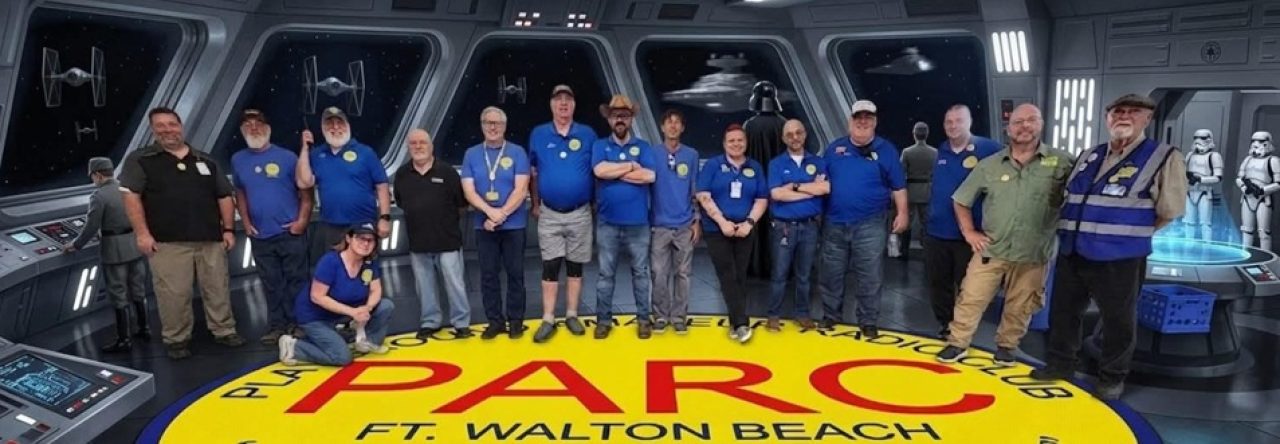
The Best Amateur Radio Club in Florida

Author: DJ Stewart Page 15 of 18

W4ZBB Field Day Success!!!

Wow what a weekend! Outside, fresh air, friendly faces, open communication, and QSO’s for Field day!

A very large thank you to all who participated, made contacts, and just flat out, had fun! This was a wonderful event for Team PARC at Fred R Gannon State Park in Niceville Florida! We hope your field day was wonderful as well! PARC racked up the contacts and used only battery and solar power! To add to that, we used gear that was designed for ease of use and rapid deployment! We would like to make a special thank you known to the Mayor of Niceville, Dan Henkel, who came out and got involved with Amateur Radio, understanding its operational capability, and seeing first hand how dependable Amateur Radio Communicators are to the community at large!

Another special thanks goes out to the Twin Cities Amateur Radio Club for attending the PARC Field Day Event and operating under the Club’s call, W4ZBB! We would also like to that the staff at Fred R Gannon State Park for having us and taking an esteemed interest in what we do, how to get licensed, what gear works good versus what does not, and offering input for future events!

Enjoy the photos below and take note of AA0EU’s ingenuity of a pole for his counterpoise!


Happy Father’s Day from Team PARC!

Happy Father’s Day from all of us at the Sunday Pile Up! We hope all of your plans are going well and that you are celebrating! Be sure to join us for more Amateur Radio fun this coming Thursday, June 20th at 730 pm CST at 17 A First St SE in beautiful Downtown Fort Walton Beach for the Club’s monthly business meeting!

Bring your guests, family and friends for all are welcome here and it is always a great time Keys down!

You might also get to meet (RFD) Romeo!


From the Shack of Michael W Pickett W9MWP!

Hi guys, just wanted to let you know that when I visited your club and joined back in March I took away one valuable idea from your hamfest. Your idea of giving everyone a badge upon paying their entry fee struck me as an incredibly great idea. It serves as proof of payment as well as a great souvenir. I brought this idea up to the organizers of our hamfest and they thought it was a great idea, so I got busy making badges, 255 as a matter of fact. We had 237 people that attended our hamfest and our treasurer that collected admission mentioned that he got more comments on the badge then he could count. Our hamfest also has tailgate sales which are out in the parking lot and we have had people in the past bypass the admissions table only to tour the outside sales. This did not happen this year due to being able to spot all the paying customers who sported their new badge. I heard a lot of great chatter on 2 meters the day after about it as no other club around here has ever done this before. Thanks again for letting me bring back one of your great ideas to Wisconsin.
Michael W Pickett  W9MWP

Exciting Month Ahead for Team PARC!

What are you doing with your hobby?!

We here at PARC are eagerly anticipating the entire month of June! We kick things off with Pile-Ups every Sunday! Moving into the month we pres right into Tech Night on the 6th of June! Then, on the 20th of June, we hold our Monthly Business Meeting!

What would come next you ask?! FIELD DAY?  That’s right! The coveted annual event in which we all take part to practice or message handling traffic and QSO contacts showcasing our skills to the public and civil servants! This year, PARC is hosting a tremendous effort to keep it simple and operate on assets which are exceptionally portable! See the Special Event Stations page from the ARRL for the specific frequencies where you can find the PARC Team!

Short of a hootnanny but more like a hoedown, this event will take the RF from battery powered gear and transmit the world over!  Be sure to participate and join in with the team! Follow this link to learn more!

FOX HUNTING SUCCESS!!!!

We sure had fun hosting the FOX HUNT! Those that joined in all found the transmitter! The winner was Tyler, KQ4ACS but the real Champion is KQ4FRB for setting the event up and taking the lead! Queenie truly is a great activities Director and wonderful addition to the Playground Amateur Radio Club!

THIS COMING WEEKEND!!!!!

-.-. — — . / — -. . / -.-. — — . / .- .-.. .-.. -.-.– / – — / – …. . / .–. .-.. .- -.– –. .-. — ..- -. -.. / ..-. — -..- / …. ..- -. – -.-.–

What’s that you say? A Fox Hunt?! You are darn tooting! Or in this case, locating the hidden fox transmitter in an undisclosed location on an undisclosed frequency somewhere in Fort Walton Beach Florida!

Excited? You should be!

The following details outline the event:

SHOW UP at the Playground Amateur Radio Club at 17 A First St SE in BEAUtiful Downtown Fort Walton Beach at 0930, 25 May, 2024! The transmitter frequency will be disclosed at that time!

Place you $10.00 buy in to support the Club’s efforts and participate in a BBQ following the hunt at the FOXES DEN! <- Not the location or a hint, but it might be a clue (ok, maybe not). Enjoy the fellowship and good sporting morning with your favorite Amateur Radio Club! The Playground Amateur Radio Club! Serving Fort Walton Beach for over 6 decades and still going strong!


FIELD DAY 2024!

Be sure to participate and volunteer!


Field Day 2024, June 22/23rd, Fred Gannon State Park, Niceville FL!!!

FOX HUNT!!!

Looking for some fun?! Head out out with the PARC Team!

From the Desk of Mike, W9MWP, Again!

coliner antenna

While it is not possible to home-brew a commercial quality antenna, it is very feasible to build a collinear antenna for average use. This article describes a collinear antenna made from very inexpensive RG58/U coaxial cable and encased in PVC pipe. FYI — This was (many years ago) for a science fair I entered. Didn’t win but had a great antenna when I was finished. Kind of looks like the modern fiberglass antennas we all have seen around..
Before we start building you need to know characteristics of coaxial cable. Remember that there is something called the velocity factor for coaxial cable. For RG58/U coax it is typically .66. This means that when we calculate the length of ½ wavelength in free space we need to adjust its size by multiplying it by the velocity factory. Simply put, RF is slowed down by the velocity factor when traveling through coaxial cable. Calculating the ½ wavelength of RG58/U coaxial cable with a frequency of 444 MHz.: I Chose 440 band because the lengths are small. Of course you can pick your own band by simply changing the frequency to say 145.47 MHz…

½ wavelength of coax = 300 / F / 2 * V Where F = Frequency in Megahertz V = Velocity factory of Coax 300 / 444 / 2 * .66 = .2229 meters or 223 millimeters or 8.78 in. (remember 25.4 mm per inch..) Since most of us don’t have mm tapes I will do this in inches.. To allow for cutting the ends of our coax, we will need to add .3 inches to each ½ wave length for a total of 9.08 inches. You will need 8 half wave lengths (9.08 inches) of RG58/U coaxial cable to be cut and connected in the manner shown in Figure 1. First cut back .16 inches of the outer jacket, braid and dielectric exposing the center conductor as in Figure 2. Now cut back the outer jacket another .16inches to expose the braid and push the braid back about a millimeter to prevent it from shorting with the center conductor. Now solder each half wavelength section as shown below. Add a few feet of RG58/U to the bottom. To add a ¼ wave element to the top of the antenna. Use #16 solid wire or similar and solder it to the center conductor only. Or on the last element you make simply make it ¼ wavelength longer than the rest and then remove the shield. The length of the ¼ wave element is calculated as follows: 1/4 wavelength radiator = 300 / F / 4 Where F = Frequency in Megahertz 300 / 444 / 4 = .1689 meters or 169 millimeters or 6.65 inches At the bottom of the array slide a 5/16 inch tube (or you can use braid from a piece of coax) over the feed point only. Solder the tube/braid to the shield of the bottom element.

The length of the tube (or braid) is calculated as follows: ¼ wavelength of tubing = 300 / F / 4 * V Where F = Frequency in Megahertz V = Velocity factory of Tubing. (Use .95 for 5/16″ tubing) 300 / 444 / 4 * .95 = .1604 meters or 160 millimeters or 6.4 inches Because a collinear antenna is hot with RF along the shield of the coax, it is necessary to prevent the RF from coming back through the coax. Slide three FT50-43 or almost any similar sized toroids over the bottom end of the coax as shown in Figure 3. The toroids should be placed about ½ wave length from the bottom of the array. Use the same formula for calculating a half wave length of coax. If you prefer, apply RF to the antenna at this point and slide the toroids up and down until minimum SWR is found. Tape the toroids to the proper point on the coax using electrical tape or similar means. Carefully insert the coax assembly into a length 1/2″ PVC pipe for final mounting. Place a cap on the top of the PVC after the antenna inserted. I taped a string to the top of the antenna (the bare ¼ wavelength) to allow me to pull the entire antenna into the PVC. On the bottom I used a cap with a hole drilled into it to mount a connector.

I used a BNC connector which fits nicely into the ½ inch PVC. You could also just extend the bottom coax through the hole and put a connector on the coax. Do not cement end caps until the SWR has been doubled checked. Do not use RG58/U for your complete feed line. Use a low loss coax such as LMNR 8 for the main feed line. After completing the assembly of the collinear antenna, apply a small amount of RF with the antenna on the ground. Low SWR should be observed at this point. Remember tuning can be accomplished with the toroids. The SWR will be lower once the antenna is mounted in the air. If the SWR is greater than 2 to 1 across the entire band, a connection may separated or a short occurred. It will be necessary to correct the problem before proceeding. After good SWR is obtained, I used heat shrink around each joint and the put a tie rap on each point. The tie rap will make the antenna fit bitter in a ½ PVC without moving around much.

If the eight ½ wave coaxial elements result in an antenna too long for your liking (over seven feet), then it is okay to use four ½ wave coaxial elements but the SWR may be slightly higher (Attach four ¼ wave vertical ground radials at the antenna feed point to help lower SWR.). No radials are needed for the eight element version. If 9 dB gain is still not enough for you then increase the number of coax elements from eight to sixteen. You will notice the antenna is getting kind of long if you do this!! Although only a 440 antenna was described in this article, the formulas can be easily calculated for any band. If you go lower than 6 meters it is going to be very LONG..


Mike, W9MWP

Scanning with Wings!

How does the Playground Team take flight? We go to an air show! Our fellow member Steve and his friend Joe went to Wichita Falls Texas and attended an air show for a fun day  on a flight line ramp and spectacular aerial performance!

The purpose of an air show is to demonstrate the capabilities of military and civilian aircraft through aerial displays and static exhibitions. This helps raise public awareness and appreciation for aviation technology and achievements. This same “give back” is the mantra of Amateur Radio and all of our capabilities. While not necessarily Ham related, the take away here should be that we all share. It provides a sense of purpose and meaning in life by allowing you to make a positive impact on causes you care about and serve your community. Volunteering gives a feeling of accomplishment and pride.


Thanks Steve for sharing aspects of life you enjoy and being a valuable part of the Playground Amateur Radio Club!


Page 15 of 18

Powered by WordPress & Theme by Anders Norén